Summary
This post explores Manned-Unmanned Teaming (MUM-T), which is the practice of pairing human operators with autonomous air, ground and maritime systems, and explains why it has become a foundational building block for Multi-Domain Operations. It covers how MUM-T works in each domain, how it links together into a connected battlefield network, provides real world examples from current defence programs, and why lessons from Ukraine are reshaping how militaries think about combining human judgement with machine speed and expendability.
What MUM-T Actually Is
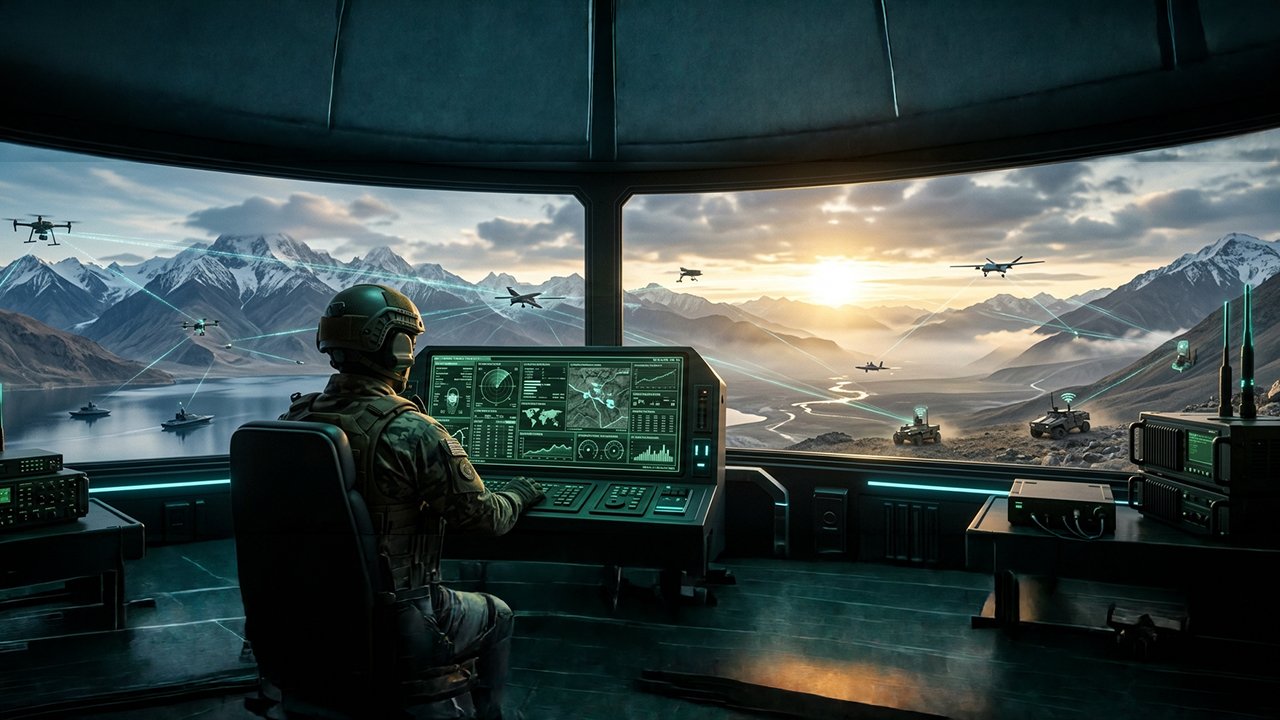
MUM-T is a synchronised operation of soldiers, manned, unmanned air and ground vehicles, robotics and sensors to achieve enhanced situational understanding, greater lethality and improved survivability. In plain terms, the human stays in or near the decision loop, while unmanned systems extend that human’s reach, senses and firepower into places too risk, too repetitive or too remote to send a person.
Rather than replacing soldiers, pilots and sailors, MUM-T is designed to make each one significantly more effective. It combines human intelligence and autonomous systems to achieve faster, safer and more efficient operations across air, land and sea.
From Separate Domains to One Connected Fight
For most of military history, the air force fought in the air, the navy fought at sea, and the army fought on land, and while coordinated, these forces remained largely separate.Multi Domain Operations (MOD) is built on a different premise: that modern adversaries can be defeated faster and more decisively when air, land, sea, cyber and space assets act as a single, integrated system rather than parallel efforts.
That premise creates an enormous practical challenge. How do you actually connect a fighter jet, an infantry squad and a naval vessel into one coherent, responsive force. The answer comes in the form of Manned-Unmanned Teaming.
MUM-T Domain by Domain
In the air, MUM-T has matured the furthest. Crewed aircraft and helicopters direct drones as forward scouts, sensor relays or weapons platforms, extending situational awareness well beyond what onboard sensors alone could provide. This cooperative approach allows unmanned systems to operate in greater distances or high-risk areas while crews retain control and decision making authority. Acting as force multipliers, these systems can support a wide range of missions, including surveillance, reconnaissance, target detection, and battlefield assessment.
On the ground, unmanned ground vehicles (UGVs) are increasingly working alongside dismounted troops and manned vehicles, supporting tasks such as autonomous navigation, coordinated patrols, surveillance, reconnaissance and logistics. These systems can operate in urban environments, remote terrain, or ground-critical infrastructure, allowing manned teams to maintain greater situational awareness while reducing exposure to potentially hazardous areas. By integrating UGVs with existing ground forces, MUM-T enables more coordinated and flexible operations across diverse mission environments.
At sea, unmanned surface and sub-surface vehicles are increasingly being integrated with manned vessels to extend surveillance and situational awareness beyond the ship’s immediate operating area. These platforms can support maritime domain awareness, reconnaissance, persistent monitoring, and underwater missions while operating in challenging or potentially hazardous environments. By combining manned vessels with unmanned platforms, MUM-T enables a wider area coverage, faster information gathering, and more informed decision making, across maritime operations.
The True Power of MUM-T: Cross-Domain Integration
Individually, each of these applications is useful. MDO’s real payoff comes from linking them together, a drone’s ISR feed, informing a ground unit’s maneuver, a naval sensor cueing an air strike, a ground robot relaying targeting data to an aircraft overhead. Industry analysis increasingly frames this cross domain connectivity as the core value proposition of MUM-T going forward, MUM-T integrated manned platforms like fighter jets, armoured vehicles and naval ships with unmanned aerial, ground and underwater vehicles to deliver superior situational awareness, survivability, and mission versatility, and nations across the U.S., Europe, and Asia-Pacific view it as critical for future battlefield dominance.
This is precisely the connective tissue MOD doctrine calls for. MUM-T capabilities can present multiple dilemmas for adversaries and deter them across air, land and sea simultaneously, rather than in one domain at a time. A force that can seamlessly move sensor data and decision authority between domains creates far more problems for an adversary than one that fights each domain in isolation.
The Russia-Ukraine Effect: Rethinking Where Humans Belong
Perhaps the most recent and consequential shift in MUM-T thinking has come out of the war in the Russia-Ukraine conflict, where sustained peer-to-peer combat has been brutally clear about the survivability of crewed platforms in a contested airspace. Scientists now describe an evolving concept sometimes called Human-Machine Teaming (HMT), where small unmanned aerial and ground systems form a part of a distributed mobile ad-hoc network. It is managed through battlefield-management systems, and supports highly autonomous unmanned assets that carry out maneuver execution once directed by human controllers.
The practical effect is a shift in the ratio: fewer exposed humans, more expendable and networked machines, with people concentrated in the roles, judgement, authorization and ethical decision making, things that machines can’t yet replace.
Beyond Combat: A Widening Set of Missions
MUM-T’s applications now exist well past strike missions. Current and near team uses span search and rescue, convoy operations, combat missions, detection, tracking and anti-submarine warfare, with swarming and multi-domain operations on the horizon as the next frontier, with technology maturing. This breadth matters for MDO in particular, since sustaining a multi-domain fight requires far more than firepower. It requires logistics, casualty evacuation, and sustained ISR, all of which MUM-T can help distribute across manned and unmanned assets.
The Growth Curve
The scale of investment behind this shift is significant. The global military manned-unmanned teaming market was valued at roughly $5 Billion in 2024, and is projected to reach 7.64 billion in 2027, growing at a compound annual rate of 15.2 percent. This is driven by evolving defence doctrines that emphasize autonomy, multi-domain operations, and enhanced force effectiveness. That trajectory reflects how central MUM-T has become to defence planning, not as a niche capability, but a foundational assumption in how future forces expect to fight.
The Bottom Line
MDO promises a battlefield where air, land and sea forces act as one coordinated system rather than three separate fights. MUM-T is the mechanism making that promise achievable, extending human senses and firepower through networks of unmanned systems, while keeping human judgement at the center of lethal decisions. As bandwidth, autonomy, and secure communications technology continue to mature, expect the boundary between manned and unmanned forces to blur further, with the winning force being the one that moves information and decisions across domains fastest.
Disclaimer : This post is intended for general informational purposes and draws on publicly available defense industry and research reporting.