Summary
Conventional military communications rely on centralised infrastructure that is vulnerable to disruption, jamming and interoperability failures. Mesh networking addresses these shortcomings through a decentralised, self-healing architecture with no single point of failure. This blog covers how mesh networks are being applied across all five warfighting domains: land, air, sea, space, and cyberspace.
Introduction
Effective communication has always been essential in military operations. Yet as adversaries have grown more sophisticated in their use of electronic warfare, jamming technologies, and cyber capabilities, the traditional model of centralised military communications has shown serious vulnerabilities. The question facing defence planners today is not merely how to communicate on the battlefield, but rather how to maintain that communication when an adversary is actively working to sever it.Mesh networking has emerged as one of the most substantive answers to that question.
Conventional military networks route information through fixed infrastructure, like relay towers, satellite uplinks, and centralised command nodes. The model is administratively convenient, but also fragile. Destroying or degrading the central node can cause the network to fail.
The tactical force’s historical reliance on satellite communications adds to this vulnerability. In a peer-level conflict, satellite connectivity may be congested, deliberately targeted, or reserved for higher echelons, which can leave frontline units without reliable communications at precisely the moment they need it most. Different service branches have further compounded the problem by developing incompatible systems over decades, making data sharing between land, maritime, and air components slow, complex and prone to failure.
A network architecture built around a single point of control is, in effect, a network built around a single point of failure. Mesh networking addresses this at the structural level by distributing communications across multiple nodes and frequencies simultaneously. This ensures that the network can remain operational, despite the threat of jamming or spoofing.

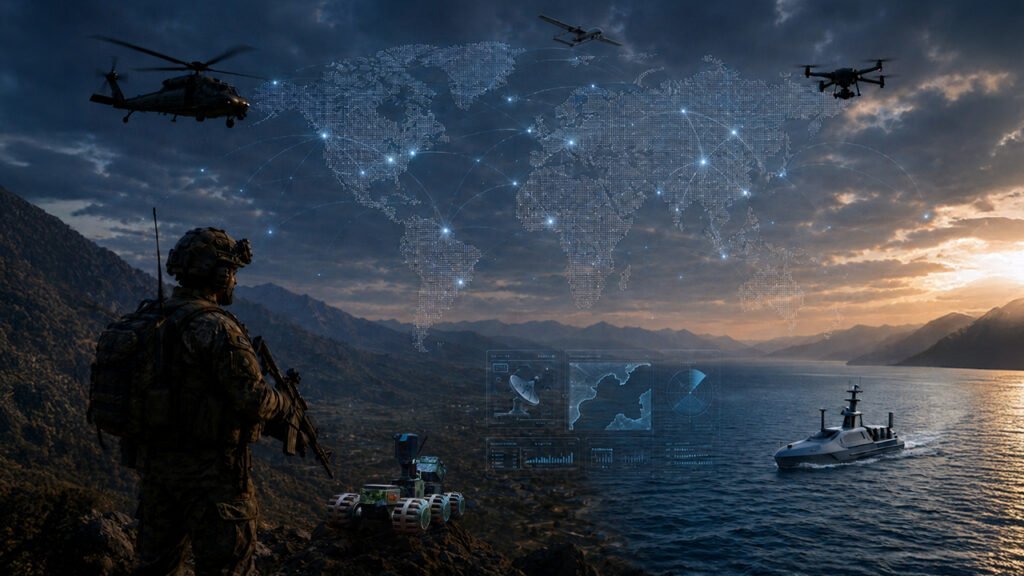
One of the most operationally significant aspects of mesh networking is its applicability across all warfighting domains. Rather than operating as separate, domain-specific systems, mesh architecture provides a common communications framework that adapts to each environment.
● On land, nodes carried by soldiers and mounted on vehicles form the tactical backbone of the network, moving and adapting with the force across complex terrain without the reliance on fixed infrastructure.
● In the air, unmanned aerial systems serve as elevated relay nodes, extending coverage beyond what ground-based nodes can achieve. Multiple UAS operating within the mesh maintain communication even when individual platforms are jammed or destroyed.